
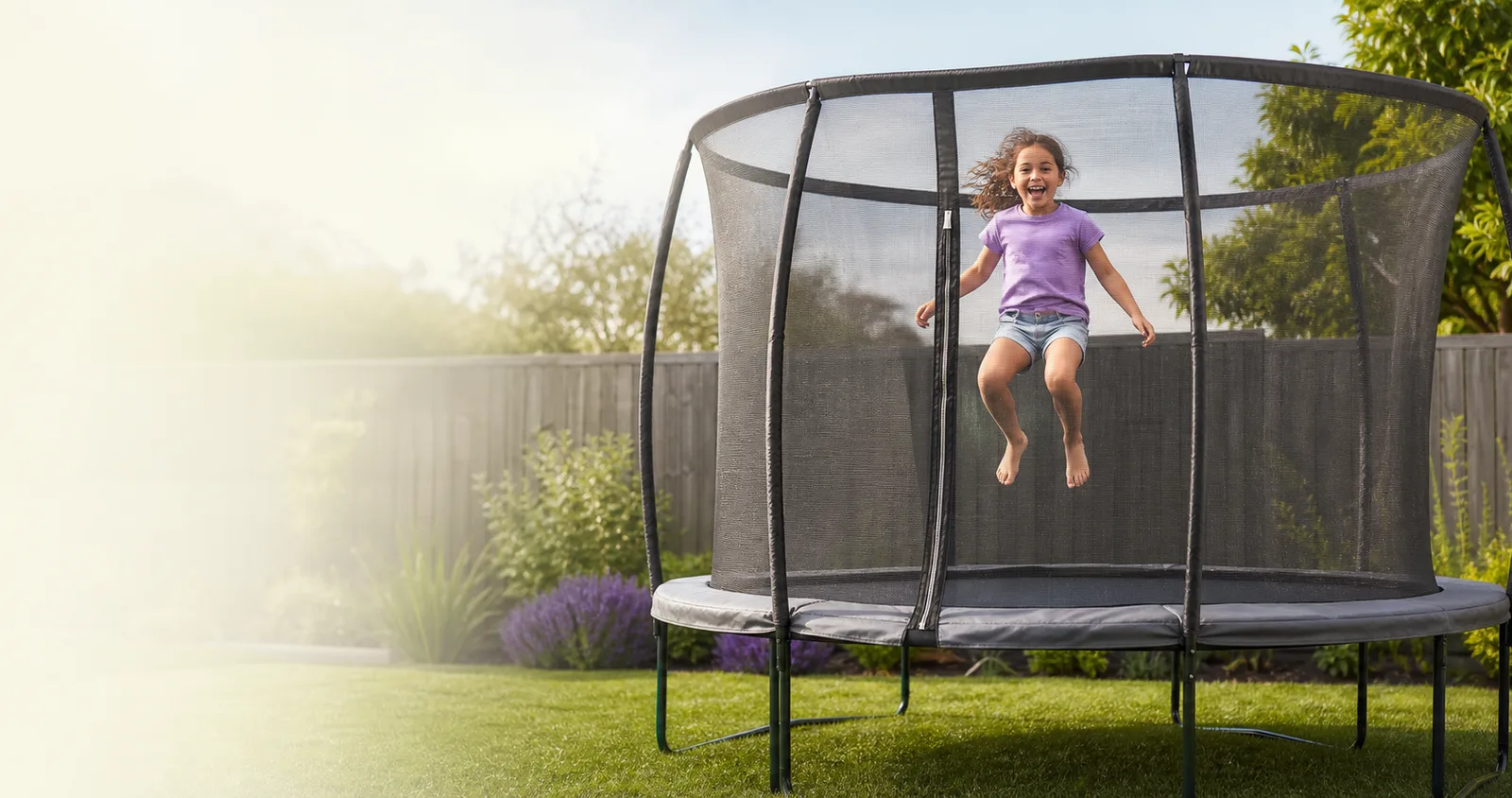
At a glance
Key takeaways
- Measure the usable yard, not the fence-to-fence distance.
- Allow clearance around and above the trampoline.
- A larger trampoline is not automatically the better fit.
- Oval and rectangular models can use narrow yards more efficiently.
- Plan access for delivery, assembly and future part replacement.
Start with the safe usable space
Measure the level area where the trampoline can sit while staying clear of fences, walls, branches, washing lines and hard landscaping. Manufacturer clearance requirements should guide the final position.
A practical family size guide
| Typical size | Often suits | Consider |
|---|---|---|
| 6–8ft | Younger children or compact yards | Limited long-term jump space |
| 10–12ft | Everyday family use | The most common suburban fit |
| 14ft+ | Larger yards and older children | More clearance and assembly space |
| Oval / rectangle | Long or narrow yards | Orientation and access |
Questions to answer before buying
- Who will use it over the next five years?
- Can the yard maintain safe clearance?
- Are replacement parts readily available?
- Will the trampoline need to move later?
- Which accessories are genuinely useful?
FAQ
Questions families ask about this topic
Is a 10ft or 12ft trampoline better?
Both suit many family yards. The better choice depends on safe clearance, child age and whether the extra mat area justifies the larger footprint.
Are oval trampolines good for narrow yards?
Often yes. Their length can make better use of a narrow site, provided manufacturer clearance is still maintained.